

Who is orthodontic treatment for?
The truth is, our teeth are almost never perfect. Orthodontic issues can happen to anybody and may have nothing to do with your dental choices — many are genetic, and others come from habits, injury, baby teeth lost at the wrong time or other medical conditions.
How do we know if treatment is needed?
There are a few common orthodontic issues that people typically come to us for. If you don’t see yours listed here, it doesn’t mean we can’t help you — request a call back and your orthodontist will give you a clear picture.
- Crowding — when there isn’t enough space in the jaw for all the teeth to fit properly
- Spacing — gaps between teeth caused by missing teeth, undersized teeth or jaw size
- Overbite — the upper front teeth overlap too far over the lower teeth
- Underbite — the lower teeth or jaw sit in front of the upper teeth
- Crossbite — some upper teeth sit inside the lower teeth instead of outside
- Open bite — the upper and lower teeth don’t meet when the mouth is closed
- Overjet (protrusion) — the upper teeth protrude significantly forward
- Relapse — teeth shifting back after previous orthodontic treatment
Nine cases we treat regularly
Each of these is a real patient of ours, shown before and after treatment.
Crowding of the teeth
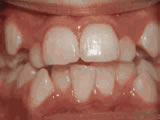
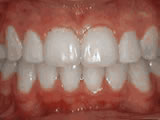
Patient started treatment at age 11 and wore braces for 26 months. He loves his new smile.
Open bite — front teeth don’t touch
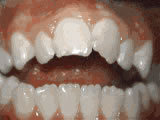
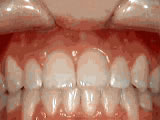
Patient sucked her thumb as a young child. She started treatment at age 13. She had braces and a special appliance — called a crib — to retrain the tongue, for 28 months. Now she can bite the lettuce out of a sandwich.
Deep overbite — lower front teeth bite into palate
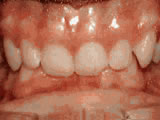
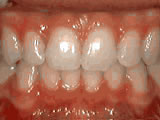
This adult patient, age 25, required braces and jaw surgery to correct his severe overbite, with treatment taking two years. His problem could have been corrected without surgery if he had been treated before he was a teenager.
Missing lateral incisors
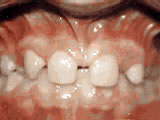
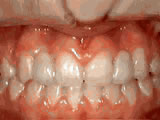
This patient’s lateral incisors were congenitally missing. She had braces for 20 months to move the teeth into their correct positions, then the missing teeth were replaced with bonded “Maryland” bridges.
Underbite — lower front teeth in front of upper teeth
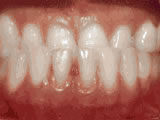
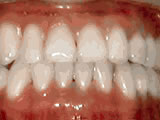
Patient’s underbite was causing her jaw joint discomfort and excessive wear patterns on her teeth. After about 30 months of treatment starting at age 32, she now finds smiling and chewing much easier.
Spacing of teeth
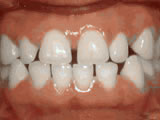
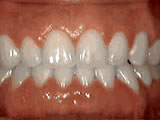
Patient was bothered by the spaces between his teeth. Braces closed the spaces and gave him an ideal bite in 24 months. Special glued-in retainers help keep the spaces closed.
Overjet — protruding front teeth
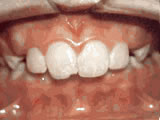
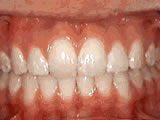
At age ten, patient had a big overjet with the top teeth protruding beyond the bottom. She had two phases of treatment. The first helped her jaws to grow more harmoniously and the second aligned her teeth and bite. At age 13, she was proudly displaying her new smile.
Several of these bites — open bite, a large overjet, spacing, underbite — can also affect speech. We cover which sounds, and what braces can and cannot do about a lisp, in Can crooked teeth cause speech problems?
Non-braces treatment
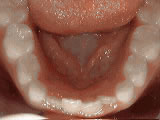
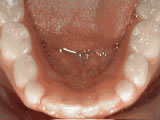
Sometimes braces are not needed to get noticeable improvements in tooth alignment. This patient was first seen at age seven for crowding of the lower permanent teeth. A procedure was performed to reduce the width of the adjacent baby teeth and the permanent incisors aligned on their own in nine months.
Phase One
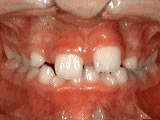
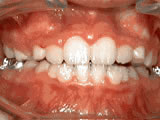
Patient’s parents were concerned about both aesthetics and the health of the erupting permanent teeth when they brought him to the orthodontist at age eight. The lower front teeth were crowded and touching the palate, and the upper front teeth were extremely displaced from their normal positions. After 12 months of Phase-One treatment with an expander and partial braces, patient’s appearance and dental function were vastly improved.